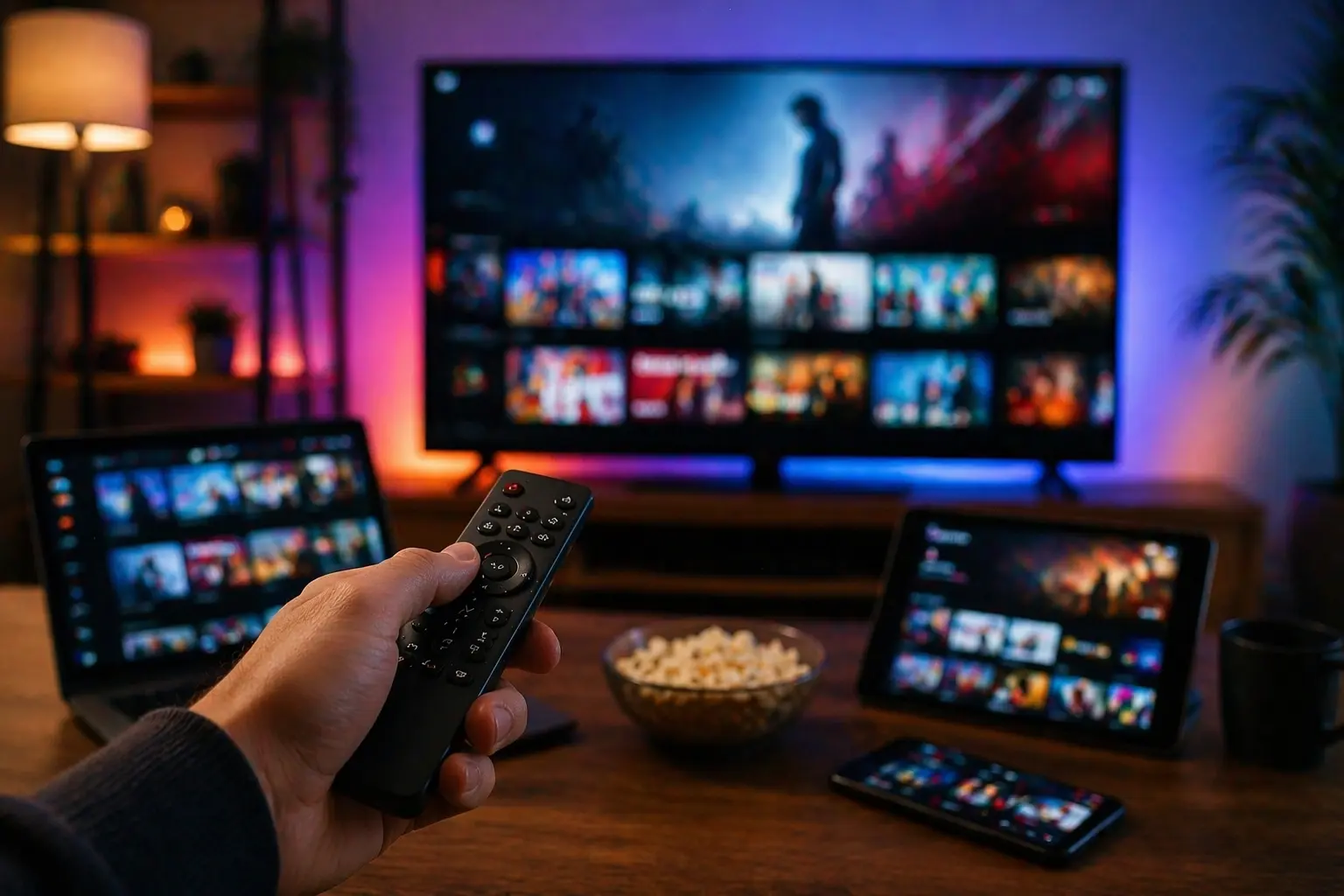
Not long ago, entertainment had a schedule. People waited for prime time, followed TV guides, and planned evenings around what the networks decided to air. If you missed a big episode, you missed it. If a show was not on your channel package, it barely existed in your routine. That world has not disappeared completely, but it is no longer the center of gravity. Entertainment now lives online — on streaming platforms, video apps, creator channels, smart TVs, and phones — and the shift is no longer just cultural. It is measurable. Nielsen reported that in May 2025, streaming made up 44.8% of all TV viewing in the U.S., surpassing the combined share of broadcast and cable for the first time ever.
That milestone mattered because it confirmed something audiences had been feeling for years: television is no longer the main door into entertainment. It is one option among many. By January 2026, Nielsen said streaming had climbed even higher, hitting a record 47.5% of TV viewing in December 2025. On Christmas Day alone, streaming broke records again, helped by major live sports and event programming on platforms such as Netflix and Prime Video.
The audience behavior behind that change is just as striking. Pew Research Center found in 2025 that 83% of U.S. adults say they watch streaming services, while only 36% say they currently subscribe to cable or satellite TV at home. That gap says almost everything about the new entertainment era. Streaming is no longer an add-on. For most Americans, it is the default.
But the story goes beyond Netflix, Hulu, Disney+, or Prime Video. The bigger transformation is that entertainment has moved onto the internet as a whole. Deloitte’s 2025 Digital Media Trends report says traditional video entertainment has been disrupted not only by streaming services, but also by social platforms, creators, user-generated content, and increasingly sophisticated recommendation systems. In other words, people are no longer comparing cable only to Netflix. They are comparing television to YouTube, TikTok, creator-led video, clips, livestreams, podcasts, short-form content, and algorithm-driven feeds that never really end.
That helps explain why the internet feels like the new home of entertainment: it offers more than programming. It offers endless choice, constant availability, and personalized discovery. Instead of waiting for a network lineup, viewers can watch what they want, when they want, on the device they already have in their hand. Instead of accepting one stream of content for everybody, they get a feed tuned to their habits, interests, moods, and attention span. This is one reason Deloitte says social and digital platforms may be becoming the new “center of gravity” for media and entertainment.
Younger audiences are pushing that change even faster. Deloitte’s March 2026 digital media monitor found that 55% of Gen Z respondents said social media content feels more relevant to them than traditional content, and 52% said they feel a stronger personal connection to social media creators than to actors and personalities they see on TV. That is a profound cultural shift. It means entertainment is no longer just about polished shows and celebrity-led programming. It is also about intimacy, relatability, immediacy, and the feeling that the people on screen belong to your online world rather than some distant studio system.
This is changing the meaning of “TV star” itself. Once, fame flowed mostly from network television, movie studios, and major cable channels. Now, influence can be built on YouTube, TikTok, Twitch, Instagram, or a podcast clip that spreads across the internet in a few hours. Traditional entertainment still matters, but it now competes with creators who speak directly to audiences every day and with platforms that reward frequency, familiarity, and emotional connection. Deloitte’s findings suggest that for many younger viewers, the creator economy is not a side category anymore. It is part of mainstream entertainment.
Even the devices inside people’s homes tell the story. Roku said in April 2026 that it had passed 100 million households using its streaming devices, and The Verge reported that Roku devices are present in more than half of U.S. broadband households. That kind of scale shows how deeply streaming has embedded itself into everyday home life. The television set may still sit in the living room, but what fills that screen increasingly comes from the internet.
Traditional media companies know this, which is why they are trying to win online rather than resist it. The occasional big month for a legacy giant, like NBCUniversal’s strong February 2026 driven by the Super Bowl and Winter Olympics, now depends heavily on cross-platform viewing and streaming extensions such as Peacock. Even when traditional brands reclaim attention, they often do so inside a landscape already dominated by digital distribution and streaming measurement.
There is also a regulatory side to the shift. In the UK, Ofcom and the government have been updating rules for video-on-demand services because on-demand platforms have become central to how audiences access content. That kind of policy response shows this is not a temporary trend or a fad created by lockdown habits. Institutions themselves are adapting to a media world where streaming and internet-based viewing sit at the center of public life.
The deeper reason entertainment has moved online is simple: the internet fits modern behavior better than television ever could. It is flexible, fast, personalized, mobile, and social. It can carry prestige dramas, viral clips, sports, creator confessionals, reality recaps, live chats, documentaries, and short videos all in the same ecosystem. It collapses the distance between viewer and platform. It also blurs the line between watching, reacting, sharing, and participating. Television was built around transmission. Internet entertainment is built around interaction.
That does not mean television is dead. Big live events still matter. Premium shows still break through. Broadcast and cable still have audiences, especially for sports, news, and major shared moments. But the hierarchy has changed. TV is no longer the unquestioned king of entertainment. It is now one branch of a much larger digital tree — and that tree is rooted online. Nielsen’s viewership data, Pew’s adoption numbers, and Deloitte’s audience research all point in the same direction: entertainment has not vanished from the screen; it has simply migrated to a different kind of screen, powered by the internet.
In the end, the biggest shift is not just technological. It is emotional and cultural. People no longer want to be told what to watch at one exact hour. They want control, relevance, variety, and connection. They want to jump from a prestige series to a creator rant, from a live sports stream to a reaction video, from a documentary to a short clip sent by a friend. Entertainment today does not live in one box in the corner of the room. It lives in the internet itself — everywhere, all at once, and always within reach.